Wired Down The Slope To Where The Guests Park
Charging for rental-cabin owners and property managers along the TN-321 corridor who now see guests pulling in with electric cars. We work out whether each unit gets its own charger or the property shares one spot, run hardwired Level 2 to a pedestal or strut rack where the parking pad actually is, and size all of it against the service you already have.
Guests are showing up with cars that need a plug.
Wears Valley rentals were wired for hot tubs, heat pumps and a full kitchen. An electric car plugged into a porch outlet overnight was never part of that plan, and some owners first hear about it when a guest asks where to charge. For a property manager running several cabins, the questions stack up fast: does every unit need its own charger, where do the cars actually park, and can the service carry another large load running for hours at night? Below is how we work through those, one property at a time.
One charger per unit, or a shared spot
A single cabin with its own meter is the simple case: one hardwired Level 2 charger on that cabin’s service, at the spot where guests park. Several units on one property give you a real choice. A charger at each unit keeps things easy for guests and spreads the load across separate services, though it means a circuit, a location and a permit at every cabin. A shared charging spot on a common parking pad means fewer chargers and one place to look after, but guests may have to trade places overnight, and that spot has to be fed from whichever service has room to spare. We look at how your units are metered, where each car parks, and how often your guests arrive in electric cars before we recommend either layout.
Pedestals and strut racks below the house
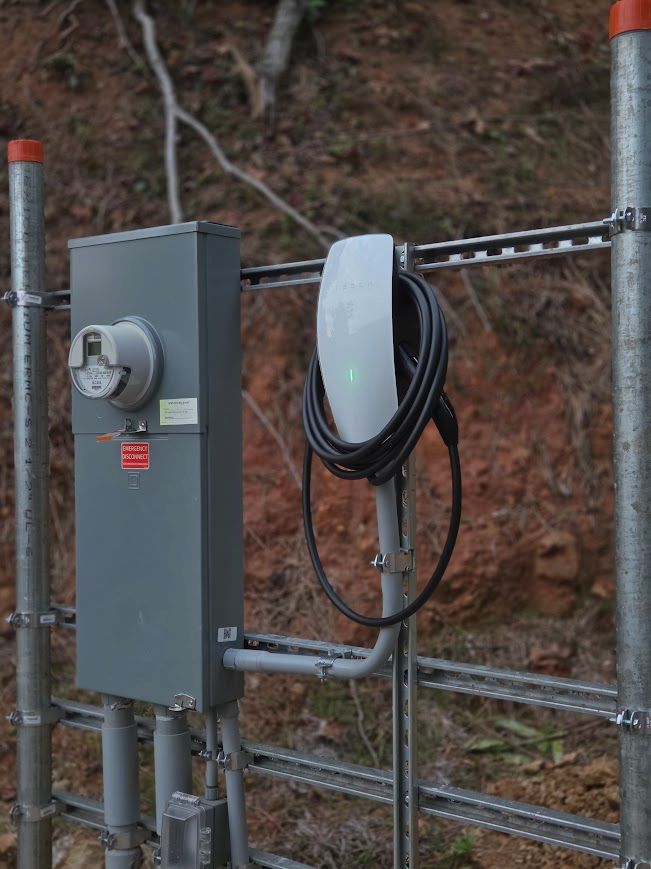
Plenty of cabins in the valley sit above their parking, with the pad cut into the slope below the house. Stretching a charging cable down a hillside is asking for a trip hazard and a damaged cord, so the charger goes where the car is. That usually means a hardwired Level 2 unit on a pedestal or a galvanized strut rack set at the pad, fed underground in conduit from the house or from a separate meter base. The photo on this page shows that kind of install: a wall connector on a strut rack beside a meter base marked emergency disconnect, with a red clay bank behind it. We plan the trench route around the slope, keep the rack clear of where cars swing in, and put the disconnect where someone can find it in a hurry.
Load calculation on the service you already have
Before any charger goes on the plan, we run a load calculation on the existing service. Most Wears Valley homes built before the 1990s are on 100A services, and cabins on 200A are often already carrying a hot tub, a heat pump or two, electric water heating and a dryer. A Level 2 charger on a dedicated 50A or 60A circuit is a big addition to that list, and it tends to run in the evening, right when the hot tub and the kitchen are busy too. The calculation tells us whether the service has room as it stands, whether a panel upgrade belongs in the plan, or whether load management is the smarter answer for that property.
When capacity is short: load management
When the numbers come back tight, there are options short of a new service. Many Level 2 chargers can be set to a lower maximum current, which slows the charge but keeps it inside what the panel can carry. A load management device can watch the whole service and throttle or pause charging while the house is drawing heavily, then bring it back when demand drops. On a property with several chargers on one service, the chargers can share an assigned amount of capacity among themselves. When a property is short in every direction, we tell you plainly and plan the service upgrade with you.
Permits through Sevier County, and the inspection
Charger circuits are permitted work. We pull the permit through the Sevier County building department, schedule the inspection, and meet the inspector on site, so the paperwork stays off your plate. The inspector looks at the circuit size, the breaker, the conduit and its burial depth on an underground run, the disconnect and the grounding. Once it signs off, we walk you or your property manager through what was installed and which breaker feeds each charger, so the next person who needs to shut one off is not guessing.
The first step is a phone conversation about the property: how many units, how they are metered, where guests park and how often they arrive in electric cars. Then we come out, look at each panel and meter, walk the route from the service to the parking, and run the load numbers. You get a free quote laying out the layout we recommend, the charger locations, any panel or load management work, and the permit. Charger brand is your call; we install the hardwired unit you choose, or help you pick one that fits the circuit.
A charger sits on top of everything else the cabin runs.
A charger is one more load on a service that may already be working hard, so the panel conversation and the charger conversation often happen together. Cabins on long overhead lines up the valley see the power-quality swings that follow storms, and a charger’s electronics are worth guarding with whole-home surge protection. If a guest reports a burning smell at an outlet they tried to charge from, or a breaker that will not reset, that is a job for emergency electrical service in Wears Valley.
Guests who arrive after dark still have to find the charger, which is where motion lighting along the drive and parking pad earns its place, and the inside of the cabin gets its own plan under custom lighting for vaulted great rooms. Our commercial EV infrastructure page covers larger sites around the area, the Wears Valley page lists everything else we do in the valley, and the gallery shows finished work. When you are ready to talk through a property, tell us how many units and where guests park.
Multi-unit charger projects start with a site visit so we can see every panel and every parking spot before anything goes in writing.
From owners with more than one cabin.
Should every rental unit get its own EV charger?
Can a charger go at a parking pad below the house?
Will my 100A service handle a Level 2 charger?
What is load management for EV chargers?
Do EV chargers at rental cabins need a permit in Sevier County?
Which charger brands do you install?
Tell us where the cars park.
Send the number of units, how each one is metered, and a photo of the panel and the parking pad. We run the numbers on the existing service and follow up with a layout that fits the property. Start with the property details, or call and walk us through the site.