Mountain Service, Sized Right
Licensed panel upgrades for Pittman Center cabins and year-round homes: NEC load calculation, long feeder runs measured and sized, permitted service change, and Sevier County inspection.
Out here, the load grew and the service never did.
Pittman Center is a small community, a few hundred people in the mountains east of Gatlinburg where the land runs up toward the national park boundary and the Little Pigeon River. Almost nothing about the electrical work here resembles a subdivision job. Properties sit well back off the road, the terrain decides where a line can run, and a lot of what stands today was wired for a modest cabin that has since picked up a heat pump, a hot tub, a well pump, and now a car that wants charging overnight.
Volt Pro Services treats a service change here as an engineering job rather than a parts swap. We start with an NEC 220 load calculation on what the property actually runs plus what you are planning to add. That calculation is required on every service change, and it is the only honest way to answer whether you need 200A or whether the real number points higher. We put the math in the written scope so you can check it and so the Sevier County inspector is looking at the same figures we are.
Distance is the variable that separates this work from the same job in town. Voltage drop grows with the length of the run, so a feeder reaching a cabin several hundred feet up a drive needs a heavier conductor than an identical load would need beside the meter. Undersized long runs are a recurring find on older mountain properties, and they show up as lights that dim when the well pump starts, motors that run hot, and equipment that dies early for no obvious reason.
Weather is the other factor. Rural feeders in this part of Sevier County take storms, ice, and falling limbs, and outages that would last minutes in a town can run considerably longer up here. Every restoration brings a surge back down the line. We install whole-home surge protection at the panel as a standard option, bring the grounding electrode and bonding up to current code, and specify weather-rated equipment where the gear lives outside. Grounding is the single most common deficiency we find on older mountain properties, and it is worth understanding that surge protection does very little without it.
Permitting and utility coordination are ours to manage. We pull the Sevier County electrical permit, schedule the inspection, and arrange the disconnect and reconnect window with the utility. Being outside a city limit changes none of that. We tell you the power-off window before we start and we hold it, which matters when a property is rented or when the well pump is the only source of water on site.
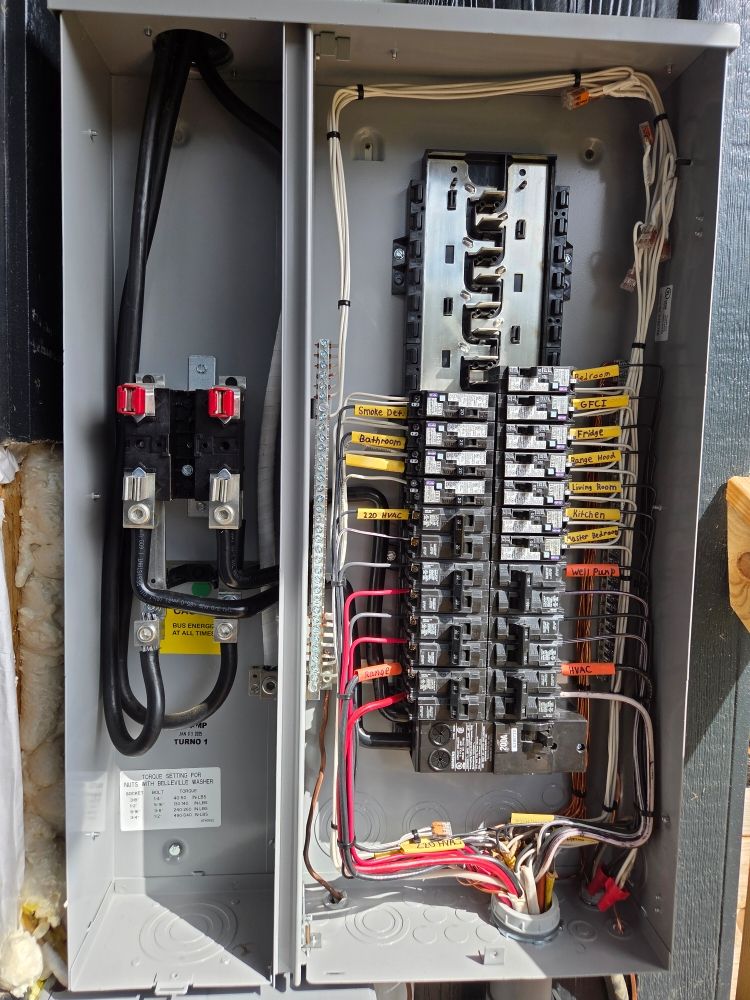
Everything is licensed, inspected, and warrantied in writing. Volt Pro Services is licensed in Tennessee and fully insured, the electrician who pulls the permit is on site for the install, and we walk the finished panel with you and hand over a labeled directory before final payment.
Six steps, start to signed off.
Site visit and load calc
We walk the property, measure the service run, and calculate NEC 220 load against what you run today and what you intend to add. The written scope names amperage, conductor size, grounding, and surge.
What we find first
Recall-class panels, undersized feeders on long runs, corroded weatherheads, and missing or failed grounding electrodes all get identified before the job starts rather than discovered halfway through.
Permit and scheduling
We pull the Sevier County permit and set the utility disconnect. If the property is rented, we build the window into a turnover gap so nobody loses power with guests in the building.
Service entrance and panel
New panel set, service entrance conductors corrected where needed, grounding electrode and bonding brought to current code, surge protection at the line side, every breaker labeled to its circuit.
Inspection and power back
The Sevier County inspector signs the work off and the utility re-energizes. Before we leave we verify voltage under load at the far end of the run, check phase balance, and confirm the ground.
Handover and warranty
Labeled directory in the door, written warranty in your hand, and the licensed electrician walks the panel with you and answers questions before any final payment changes hands.
The panel is rarely the only thing on the list.
A service change is usually the first move in a longer plan, because it is the piece everything else depends on. Once the capacity is there, the additions that were previously off the table become straightforward. The most common follow-ups on properties around Pittman Center are backup power and charging, both of which are far cheaper to accommodate while the service is open than to retrofit afterward.
Standby power is the one owners here ask about most, and generator installation pairs naturally with an upgrade because the transfer equipment lands right at the new panel. Overnight charging on a property set well off the road is its own sizing question, which is why EV charger installation belongs in the same load calculation rather than a separate conversation a year later. If something is already misbehaving, our electrical repair work often turns up the reason a panel is struggling in the first place, and lighting installation on cathedral ceilings, decks, and long driveways is a frequent companion once there are circuits to spare. Photographs of finished panels and completed work are in the gallery, and you can reach us any time through the contact page.
Straight answers.
My cabin is a long way off the road. Does that change the panel work?
What size service should a Pittman Center cabin be on?
Do I need a permit and inspection out here?
I rent the cabin out. How do I schedule around guests?
How does a mountain outage affect what you install?
Free panel upgrade quote.
Call and we will drive out, measure the run, calculate the load, and put a real scope in writing for your Pittman Center property. No deposit and no pressure. Send us the details and we will get it on the calendar.