Light For Dark Mountain Nights
Driveway and approach lighting, path and step fixtures on sloped wooded lots, deck and porch work on cabins, and motion or photocell control that runs a property when nobody is there. Licensed, insured, permitted where the scope calls for it.
Up here, lighting is mostly an outdoor problem.
Ask an electrician about lighting in a valley subdivision and the conversation turns to recessed cans and pendant placement. In the mountains east of Gatlinburg the conversation starts outside, because that is where the difficulty lives. Properties sit well back off the road behind long approaches. Tree cover is heavy enough that dusk arrives early and full dark arrives fast. And a good share of the housing is cabins and rentals, where a guest is pulling in after a five-hour drive, at night, onto ground they have never walked.
So we start with the approach. A long gravel drive is not one fixture problem, it is a run-length problem. The distance from the panel to the far end of the drive determines whether we are looking at a line-voltage run with fixtures spaced down its length, or a low-voltage system fed by a properly sized transformer, or some combination with a serviceable junction partway up. Voltage drop over a few hundred feet is real and it is the reason a system installed on a guess dims out at the far end. We measure the run, we look at where the grade turns and where the drive bends out of sight, and we place light where a driver actually needs to see rather than at even intervals for the look of it.
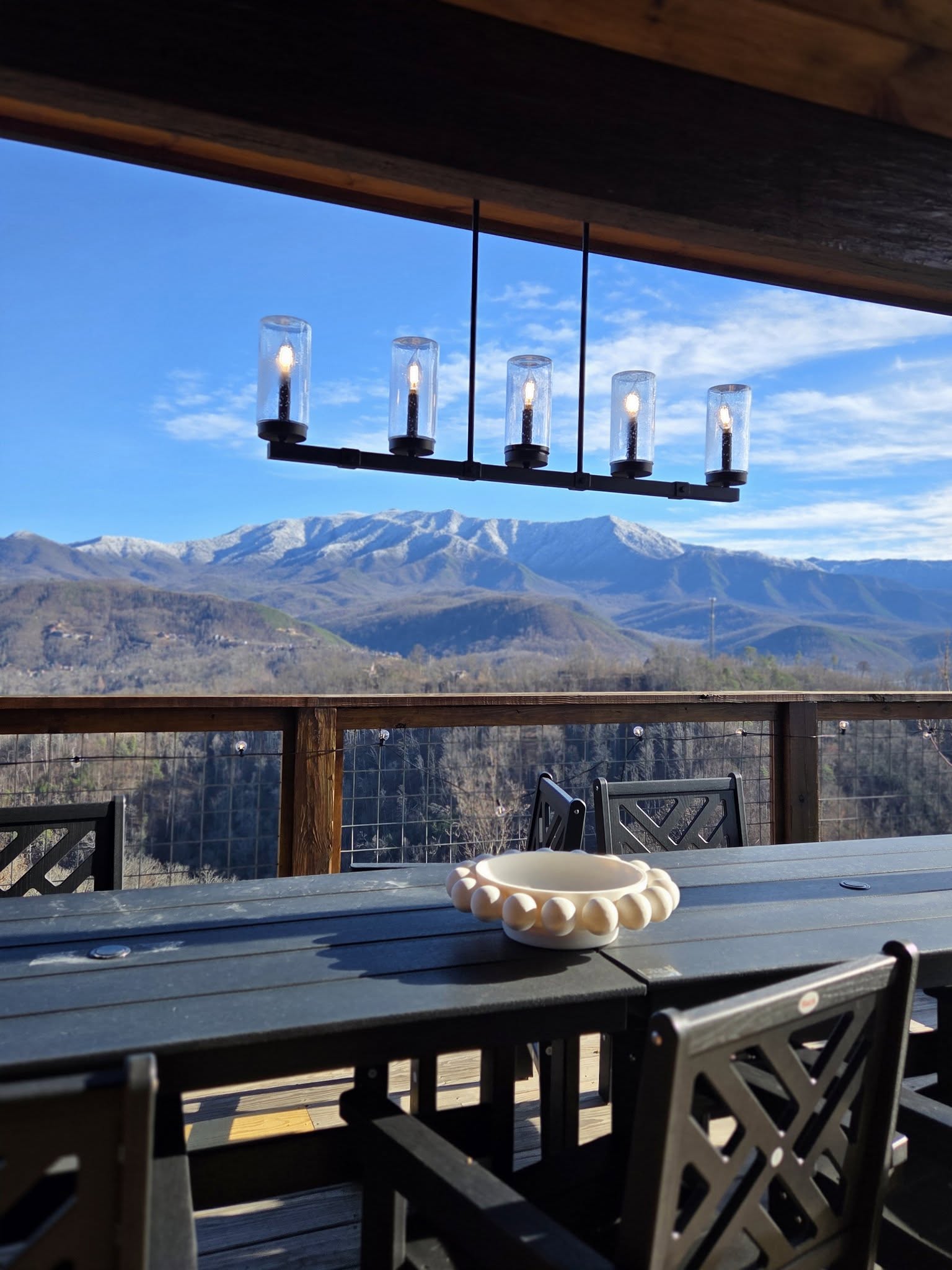
Deck and porch lighting matters more here than most places because on a cabin the deck is most of the living space. People eat out there, sit out there in the cold, and use it well past dark. That calls for layers rather than one bright fixture: something soft along the rail or under the cap for the space itself, dedicated light on the steps down to the yard or the hot tub, and a switched fixture at the door that a guest can actually find. We wire the deck lighting so it can run separately from the security lighting, because the two want different brightness and different hours.
Controls are where a rental property is either easy or a headache. Nobody is standing in the house at dusk to flip a switch. Photocell control brings the approach and the porch on when the light drops and shuts them off at dawn without anyone involved. Motion sensing handles the parking area and the side doors so light comes up when someone arrives instead of burning all night. An astronomic timer holds the deck and path run on a window you choose.
Inside, the cabins bring their own problem. Great rooms with exposed beams and ceilings running fifteen to twenty-five feet mean a fixture change is not a step-ladder job, and treating it like one is how people get hurt. We bring the right access equipment, and before anything hangs we verify what the existing box is anchored to, because a fixture mounted to decking or to a box someone toe-nailed to a rafter is not carrying a heavy piece for long. We mount to solid framing. Where a chandelier or a large fan is going in somewhere you will eventually need to reach again, we will talk through a lift or winch mount so the next bulb change is not a whole production.
Volt Pro Services is licensed in Tennessee and fully insured. We pull the Sevier County permit and coordinate the inspection when new circuits or structural work are involved, and we say plainly when a job does not need one. The licensed electrician who walks your property is the one who does the work, and the labor warranty is written.
Six steps from the first visit.
Walk the property after dark
Where a car actually stops, where the walk turns, where the steps are, and how much light the canopy is already taking away. Daylight hides most of what a lighting plan needs to solve.
Measure the runs
Distance from the panel to each fixture group decides line voltage against low voltage, conductor size, and transformer capacity. Guessing at this is why long driveway systems dim out at the far end.
Spec fixtures and controls
Wet-rated housings that survive the canopy, and a control scheme suited to how the property is used: photocell, motion, timer, or switched, and which fixtures share a circuit.
Permit and circuit work
Sevier County permit and inspection where new circuits or structural work are involved. We confirm the existing circuit can carry what we are adding before we add it.
Install and aim
Trenching at proper depth, solid framing for anything hung indoors, and every fixture aimed on site at night so the light lands on the tread and the drive instead of into someone’s eyes.
Hand off and warranty
Controls labeled, schedules set with you, a walk of the finished system, and a written labor warranty. Rental owners get a plain explanation their cleaner or manager can follow.
Lighting is usually not the only thing on the list.
Most of the lighting calls we take in this part of Sevier County turn up something else along the way. An owner adding exterior lighting to a cabin finds the service has no room left for it, which is a panel upgrade conversation before it is a lighting one. A property adding a Level 2 charger for guests needs the load calculated first, which is where EV charger work starts. Owners on this corridor also ask about standby generators more than most, because the upper reaches of the county sit through longer outages after ice than the valley does, and a rental with no power in January is a canceled booking. And when something already installed stops behaving, that is electrical repair rather than new work.
You can see the full range we cover on the Pittman Center service page, or look through finished installations in our project gallery. If you would rather just talk it through, send us the details and we will tell you honestly whether it is a one-visit job or something larger.
Questions we get out here.
How far can you light a long gravel driveway?
Can lighting be set up so a rental property lights itself?
Do you work in cabins with tall open ceilings?
What holds up outdoors in this kind of weather and tree cover?
Is a permit needed for lighting work here?
Are you licensed, and is the work warrantied?
Free lighting quote.
Call and we will drive out to your Pittman Center property, walk it after dark if that is what the job needs, and put a real scope in writing. Send us the details or see finished installations in the gallery.