Old Farmhouse Wiring, Brought Up To Today
For the older farmhouses in Boyds Creek and the rooms that got added on over the decades. We look at the service entrance on the siding, the panel behind it and the circuits it feeds, then tell you plainly what needs replacing now, what can wait, and what is fine as it stands. Two-prong outlets, ungrounded runs, tired kitchen and bath circuits and closed-in porches all come up.
Farmhouses that have been stretched for decades.
A farmhouse that has stood for generations has usually been rewired in pieces. One owner added a bathroom, another closed in the porch, someone ran a circuit to the freezer in the back room, and the panel took each new breaker without anybody asking what it was carrying altogether. None of that is unusual, and none of it means the house is unsafe. It does mean the right first step is to look at the whole system before touching any single part of it.
Meter base, riser and panel, replaced as one job
The service entrance on an older house is a set of parts that aged side by side: the meter base on the siding, the riser carrying the conductors up toward the utility connection under the eave, and the panel mounted below or inside. Swapping only the panel can leave a weathered meter base or a cracked riser feeding brand new breakers. When the service needs work, we usually scope all three together, coordinate the disconnect and reconnect with the utility, pull the Sevier County permit, and set everything plumb and sealed against the siding so rain runs off instead of in.
When 100A is carrying more than it was built for
The usual signs are a main breaker that trips, or lights that dip when the air handler or the well pump kicks on. Before recommending anything, we run a load calculation on what the house actually has: range, dryer, water heater, heat pump, well pump, freezer, shop tools. Sometimes the answer is a 200A upgrade. Sometimes the service is fine and the trouble is a few overloaded branch circuits that need splitting up. Adding an EV charger, a hot tub or a workshop sub-panel later usually tips the math toward 200A, and we will say so up front.
Two-prong outlets and runs with no ground
Plenty of older rooms still have two-slot receptacles fed by cable that carries no ground wire. Swapping in a three-prong outlet by itself only hides the problem. Depending on the run, we pull new grounded cable to those outlets, add a ground where the wiring allows it, or protect the circuit with GFCI and label the outlets as required. We explain which option fits each room and why, since a bedroom with a lamp and a phone charger asks less of its wiring than a room full of computer equipment.
Kitchen and bath circuits brought up to date
Older kitchens were often wired with one or two circuits feeding every countertop outlet, which is why the toaster and the coffee maker cannot run at the same time. When a kitchen or bath gets remodeled, we bring it in line with what those rooms need now: dedicated small-appliance circuits along the counter, GFCI protection near water, a properly sized circuit for the range or cooktop, and exhaust fans that actually vent outside. We coordinate with whoever is doing the cabinets and tile so the boxes land where the finished surfaces will be.
Outlets in rooms that used to be porches
A porch closed in years ago often ends up with one outlet tapped off some other circuit, or with power borrowed from the exterior light. Now it is an office, a sunroom or a kid’s bedroom, and it needs real outlets, proper switching and maybe a mini-split. We trace where its power comes from, find out what else shares that circuit, and give the room its own feed when it needs one. If the old porch ceiling hides a junction box nobody can reach, we find it and make it accessible again.
What the attic and crawlspace tell us
A good share of an old house’s wiring history is hidden overhead or underneath. In the attic we look for splices hanging in open air with no box around them, cable chewed by rodents, and old runs buried under insulation they were never meant to sit under. Below the floor we check for wiring stapled loosely to the joists, abandoned circuits that may still be live, and connections made close to damp ground. Very little of it needs to be cut open to find. A flashlight and a careful look usually tell us whether the hidden runs are fine or belong on the list, and anything that does gets marked by priority so you know which items matter first.
Honest scoping comes first. We walk the house with you, open the panel, test a sample of outlets in each room and look over the service entrance outside. Then you get a free quote that separates what should be fixed now from what can wait for a remodel, so the work can be planned around your budget instead of arriving all at once.
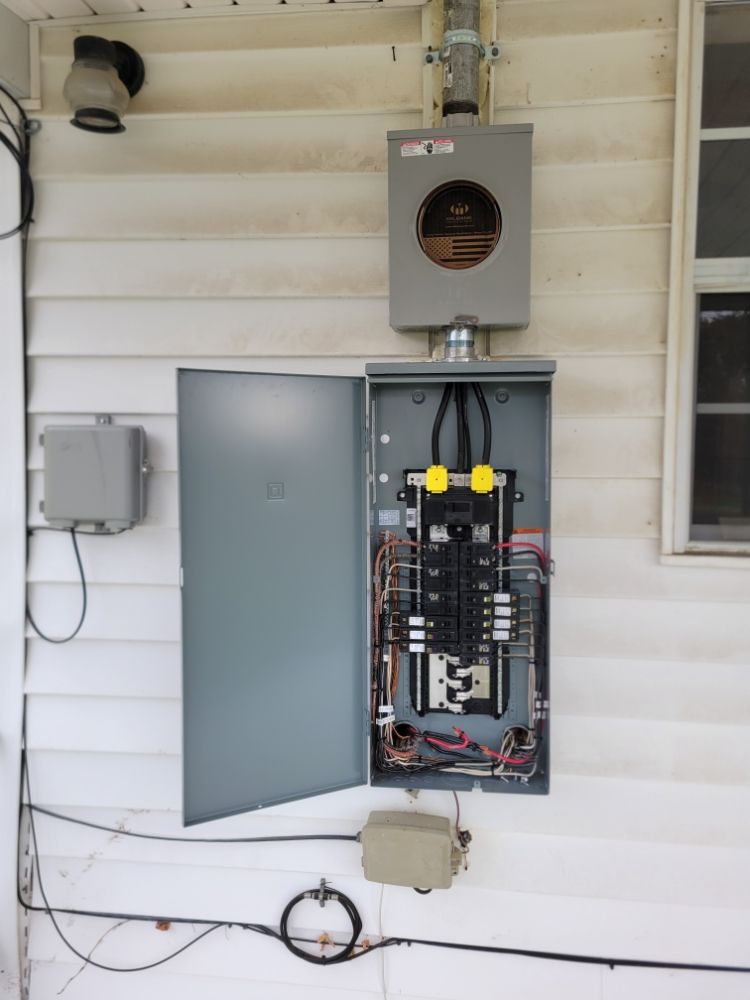
The house rarely needs only one thing.
Once the service entrance is sound, the rest of the house gets easier to plan. An older home with a fresh panel is a good candidate for whole-home surge protection at the panel, which guards well pump controls and appliance boards on a rural line. A breaker that trips under one particular load, or a dead outlet with nothing tripped anywhere, goes to troubleshooting in Boyds Creek before anything gets replaced. If you are building an addition instead of updating old rooms, the plan looks more like new construction electrical for Boyds Creek parcels, and the fixture over a new staircase belongs with custom lighting in Boyds Creek.
Our residential electrical page covers house work through our wider area. Everything else we handle locally is on the Boyds Creek overview, and finished panels and service entrances are in the gallery. To get on the schedule, tell us about the house and roughly how old it is.
We cover all of Boyds Creek, and most jobs there are reached same-day or next morning.
What farmhouse owners ask us first.
Should the meter base be replaced when the panel is?
How do I know if my 100A service is too small?
What does an ungrounded outlet mean for my house?
Our kitchen trips a breaker when two appliances run. Why?
Can an enclosed porch be wired as a bedroom?
Do we have to fix everything at once?
Start with a look at the panel.
Send a photo of the panel and the meter outside, the rough age of the house, and anything that has been added on. We follow up by phone, set a time to walk it, and put the findings in a free quote. Send the house details, or call and tell us what has been acting up.